Part of: Paying in Vietnam
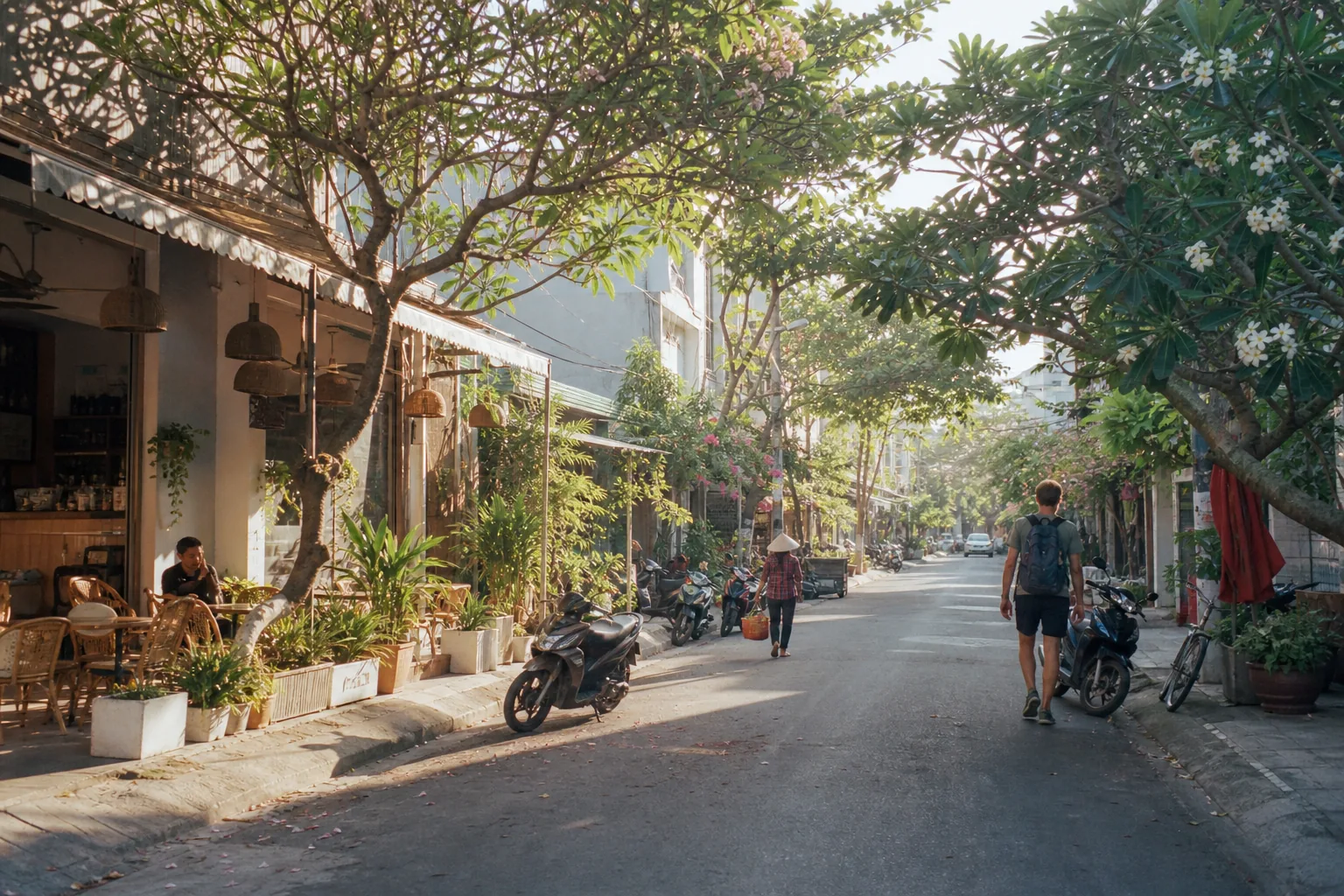
An Thượng decides most of the workday before you’ve opened your laptop. It’s home to nearly every serious café and coworking option within an easy walk of the beach. The fiber is fast, the coffee is taken seriously, and the clock plays favorites: kind to a European client, tough on an American one.

Desks are everywhere in the nomad grid. The skill is matching the room to the call.
Where the work gets done
Let An Thượng's cafés be your default desk
An Thượng is unambiguously the center of Da Nang's laptop-café scene. XLIII Coffee, the specialty roaster many still call 43 Factory, is the standout (Central Vietnam's flagship roaster, floor-embedded outlets, a genuine hub for foreign remote workers), alongside Gozar's dedicated quiet floor, the multi-story Lighthouse Café near My Khê, and Roots, Login, Lu's and Good Folk clustered a few streets over. They fill with tourists and nomads by mid-morning; an early start, or a Hải Châu-side café, buys you more quiet.
Book coworking for the call that can't drop
Enosta Space (formerly Enouvo Space), on the An Thượng/Sơn Trà border, bills itself as Da Nang's first dedicated coworking-and-coliving space and is the one most 2026 guides call the nomad favorite. ACE Coworking sits on the edge of An Thượng; DNC (widely rated the best straight coworking room in the city) shares a Hải Châu building near the river with the DNES incubator; cirCO sits thirty floors up with Han River views; Space A is the pick near My Khê. All run day passes and monthly desks for whenever a home base isn't enough.
Anchor serious work on apartment fiber, not café wifi
Residential fiber (FPT Telecom is the dominant provider) is fast by any city's standard, current plans running from roughly 300 Mbps to a full gigabit. Café wifi is a different story: speeds swing widely from café to café and slow down when a place fills up, fine for email and Slack, rough for a video call with a shared screen. If a call has to hold, run it from an apartment or a coworking desk, not a busy café table.
Work with the clock, not against it
Da Nang runs on Indochina Time, UTC+7, with no daylight saving to track. That's a genuine gift for European teams (late afternoon here, roughly 4 to 6pm, lines up with late morning in Central Europe) and a real ask for American ones, since a normal Da Nang workday falls in the evening-to-overnight window on either US coast. Most remote workers here front-load deep work before the cafés fill up and lean on async habits for the US side of the job.

The café covers most days. The coworking desk is for the one call that can't.
Mistakes to avoid
Trusting café wifi for the call that matters
An Thượng's cafés are built for lingering, not for a client call that absolutely cannot drop. Book a desk at Enosta, ACE, DNC or Space A instead whenever the stakes are that high.
Assuming every neighborhood has a café-work scene
The café and coworking density lives almost entirely in An Thượng, with a handful of serious spots in Hải Châu. Base in Sơn Trà, Ngũ Hành Sơn or Thanh Khê and you're commuting in for a desk most days, so factor that into which neighborhood you pick, not just the rent.
Expecting a comfortable US overlap
Da Nang runs UTC+7 year-round, and American teams feel every hour of it. There's no clean daytime overlap with either US coast. Set that expectation early and build the job around async habits rather than hoping for a shared 9-to-5.
Skipping the backup line
The fiber is genuinely good, but keep a prepaid SIM (Viettel or Vinaphone both sell data plans) as your fallback for the day the router acts up. When a call is mission-critical, a coworking day beats gambling on a fix.
Common questions
Is the wifi reliable in Da Nang?
For a home base, yes. Residential fiber is genuinely fast and cheap by regional standards, with FPT Telecom the dominant provider. Café wifi is a rougher story: speeds swing widely from café to café and slow down when a place fills up, fine for email and Slack, not built for a video call with a shared screen. Keep a prepaid data SIM as backup, and treat coworking as the fallback for anything mission-critical.
Best neighborhood to work from?
An Thượng, by a wide margin: it's the center of Da Nang's café-and-coworking scene, with the sub-areas locals call Bắc Mỹ An, Bắc Mỹ Phú and An Hải Đông all effectively part of it. Hải Châu is the city-center alternative, with river-view coworking and thinner café density. Base anywhere else (Sơn Trà, Ngũ Hành Sơn, Thanh Khê) and you're commuting in for a desk most days.
What's the timezone overlap with the US?
Slim. Da Nang runs Indochina Time, UTC+7, with no daylight saving to track, and a normal 9-to-5 here falls in the evening-to-overnight window on either US coast. There's no natural daytime overlap. Most remote workers front-load deep work before the cafés fill up and lean on async habits for the American side of the job.
Will a café let me sit and work all day?
Gladly. The culture here is built for lingering, same as the rest of Vietnam. Multi-story cafés with quiet upper floors are common in An Thượng, and one drink generally buys you a seat for as long as you want it. The one catch: An Thượng's cafés fill with tourists and other nomads by mid-morning, so an early start or a Hải Châu-side café buys more quiet.
Do I need to join a coworking space, or are cafés enough?
Cafés cover most days. Join a coworking space for the call that absolutely can't drop, or if you want a dedicated line as your default. Da Nang has a real spread now: Enosta Space and ACE Coworking in An Thượng, DNC and the DNES incubator on Trần Phú in Hải Châu, cirCO with river views above the Crowne Plaza, and Space A near My Khê.